
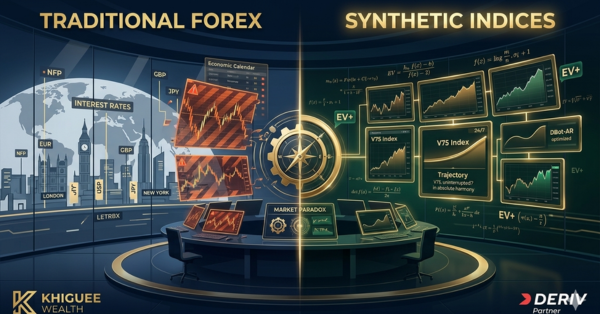
When choosing where to deploy capital, the comparison of Synthetic Indices vs Forex is one of the most debated topics among modern technical traders.
At Khiguee Wealth, we believe in dissecting these markets objectively to help you determine which vehicle best aligns with your financial roadmap.
1. Market Hours and Availability
The most immediate operational difference is when you can actually execute trades.
- Traditional Forex: Bound by central banking hours and global liquidity hubs, the foreign exchange market operates 24 hours a day, 5 days a week.
- It closes on weekends, which introduces the risk of “weekend gaps” where prices jump over your stop-loss on Monday opening.
- Synthetic Indices: Powered by cryptographically secure algorithms, synthetic indices operate 24 hours a day, 7 days a week, 365 days a year.
- There are no holiday closures or weekend gaps, providing continuous trading conditions and seamless execution for automated tools like the DBot-AR.
2. Geopolitical and Fundamental Noise
Understanding what drives the price is critical for choosing your analytical strategy.
- Traditional Forex: Driven by reality. Interest rate decisions, NFP reports, geopolitical crises, and inflation data trigger massive, often unpredictable price moves. A single central bank speech can instantly invalidate hours of technical analysis.
- Synthetic Indices: Driven by mathematics. Because these indices are simulated using audited Random Number Generators (RNGs), they are completely unaffected by real-world news, geopolitical conflicts, or economic data.
- This creates a pure technical playground where price action, SMC (Smart Money Concepts), and algorithmic logic hold absolute consistency.
3. Volatility Profiles and Risk Management
Predictability of market movement dictates how effectively you can protect your capital.
- Traditional Forex: Volatility is highly variable. A currency pair can drift sideways for days, only to experience an aggressive 200-pip spike in seconds during high-impact news, leading to severe slippage.
- Synthetic Indices: Volatility is constant and structured. For example, the Volatility 75 index is designed to maintain a consistent 75% volatility profile.
- This allows you to calibrate your lot sizing and risk parameters with extreme mathematical precision.
Aligning with Your Strategy
There is no “superior” market, only the one that fits your execution model. If you prefer analyzing macroeconomic trends and trading specific sessions, traditional Forex remains a powerful vehicle.
However, if you rely on pure price action, 24/7 automation, and a market free from fundamental noise, Synthetic Indices combined with the DBot-AR offer a clean, highly engineered path to consistency.
Ready to transition from the chaos of macro news to the precision of algorithmic markets?
Join the Khiguee Wealth VIP Portal to download our V75-specific automation setups.
🛡️ Risk Disclosure
Both forex and synthetic indices trading carry high levels of risk. Always employ strict risk management and never risk capital you cannot afford to lose. Content for educational purposes only.